What Is the Best Depth Filtration System in 2026?
Choosing the best depth filtration system in 2026 is not a simple product comparison.
The right system depends on the liquid, contaminant load, flow rate, temperature, and cleaning strategy. A sparkling beverage, vaccine solution, and industrial coolant require very different protection. One cartridge may remove visible particles, while another controls microbial risk or protects a downstream membrane.
Filtration researcher Dr. Wolfgang Ripperger has stated, “There is no universal filter; performance depends on the process.” That principle remains highly relevant.
The best depth filtration design begins with evidence. Examine particle-size distribution, viscosity, pressure limits, and filter media compatibility. Then review operating data from pilot tests or previous production batches. Laboratory ratings alone can mislead.
Look beyond pore-size claims.
A filter rated at five microns may perform differently under real process conditions. Fiber structure, cake formation, turbidity, and pressure increase all influence service life. Operators should record inlet pressure, outlet pressure, throughput, and replacement timing.
In 2026, stronger systems may combine graded-density media, automated pressure monitoring, and digital maintenance records. Sustainability also matters. Reduced waste, longer service intervals, and safer media handling can lower total ownership costs.
Still, technology does not remove uncertainty. A highly automated unit can fail when sensors drift or cleaning procedures are poorly followed. This is where experience matters.
This guide compares depth filtration systems through practical criteria, including clarification efficiency, contamination control, scalability, validation support, and lifecycle cost. It also examines where common assumptions break down. The “best” option may not be the most advanced one. It may be the most consistent, measurable, and supportable system for a specific process.
Define Depth Filtration: Media Types, Pore Sizes, and Beta Ratios
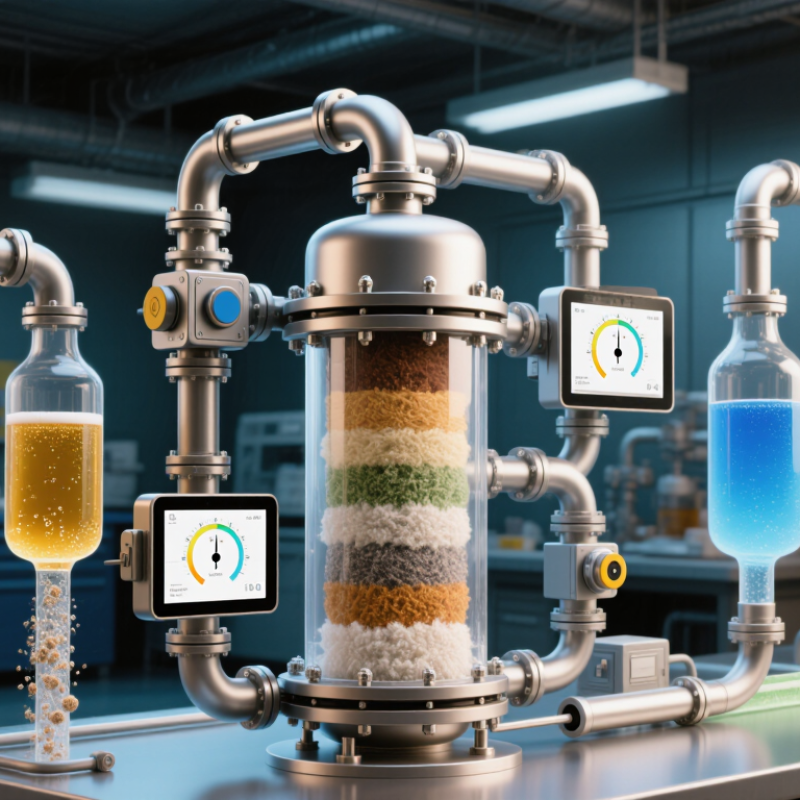
What makes the best depth filtration system in 2026 depends on the contaminant, not a fashionable housing. Depth filtration traps particles throughout a porous matrix, unlike surface media that mainly capture them on one face.
Common media include cellulose, polypropylene, polyester, glass fiber, and layered composites.
Cellulose can offer economical dirt holding, while synthetic fibers often provide a cleaner, more consistent structure.
But material names alone do not prove performance.
A pore-size label needs careful reading. Nominal ratings describe approximate removal, while absolute ratings claim a defined retention level under specified conditions. Those conditions matter: liquid viscosity, flow rate, temperature, particle shape, and loading can change results.
A filter marked five microns may behave differently in cold syrup and room-temperature water. That detail is easy to miss. The strongest purchase decision connects the rating to the actual process.
Beta ratio adds a measurable comparison. Beta 5 equals the upstream particle count divided by the downstream count at five microns.
1,000
A beta ratio of 1,000 means 99.9 percent removal at that stated particle size.
It does not mean every smaller particle is removed. Ask for test methods, pressure-drop curves, capacity data, and independent verification.
In practice, a high beta ratio with rapid clogging may be less useful than balanced retention and service life.
I would recheck assumptions after installation, because real fluids rarely match laboratory conditions. That is where a technically impressive choice can disappoint.
Compare 1–100 µm Sediment Ratings and Dirt-Holding Capacity
What Is the Best Depth Filtration System in 2026?
Compare 1–100 µm Sediment Ratings and Dirt-Holding Capacity
Choosing the best depth filtration system starts with the sediment rating, not the product label. A 1–5 µm filter can capture fine silt and visible haze. However, it may clog quickly in water carrying heavy sediment. Ratings from 10–25 µm often suit general prefiltration. Larger ratings, such as 50–100 µm, can protect downstream equipment from sand, rust flakes, and coarse particles.
Dirt-holding capacity matters just as much. It describes how much contaminant the filter can retain before pressure rises or flow declines. A filter with a smaller rating is not automatically better. In practical testing, a 10 µm depth filter may last longer than a 1 µm cartridge when the water contains mixed particles. Monitor pressure before and after the filter. A steady increase often gives more useful information than the printed rating.
My first mistake was focusing only on micron size. That approach ignored particle loading and replacement costs. It also overlooked uneven sediment distribution. A 100 µm prefilter can extend the service life of a finer stage, while a 1 µm final stage improves clarity. Yet every installation behaves differently. Water analysis, flow rate, filter thickness, and available surface area should guide the choice. Check both nominal and absolute ratings, because manufacturers may define them differently. Some specifications remain incomplete. Careful records are still essential.
What Is the Best Depth Filtration System in 2026?
Comparison of common sediment ratings from 1–100 µm and their indicative dirt-holding capacity.
Finer depth media provide better capture of small particles, while coarser media generally allow greater flow and longer loading intervals. Dirt-holding capacity depends on media depth, density, sediment composition, pressure drop, and test conditions; the capacity values shown are a normalized comparison index rather than a universal specification.
Assess Flow Rate and Pressure Drop Using Manufacturer Test Data
What Is the Best Depth Filtration System in 2026?
The best depth filtration system is not defined by its advertised micron rating. Flow rate and pressure drop reveal its real operating value. Manufacturer test data should show clean pressure drop, rated flow, test fluid, temperature, and endpoint pressure. Without these details, comparisons become unreliable.
ISO 16889 supports repeatable multipass testing for filter performance, although it does not replace application-specific water testing. For drinking-water projects, WHO’s Guidelines for Drinking-water Quality recommend turbidity below 1 NTU before effective disinfection. That target makes pressure stability important. A filter that starts at 0.08 bar but reaches 1.5 bar quickly may create maintenance problems. Look for curves at several flow rates, not one impressive maximum. Real installations rarely match laboratory conditions. That matters.
Tips: Compare pressure drop at your actual flow rate. Then check the dirt-holding capacity and test endpoint. Leave operating margin, preferably 15–25%, because viscosity, temperature, and suspended solids can change.
A practical review should calculate pressure drop across the entire housing, not only the media cartridge. The U.S. EPA’s 2024 Water Reuse Action Plan emphasizes reliable treatment barriers and consistent monitoring, supporting this broader approach.
Ask manufacturers for three repeated test runs and raw data. If only averaged results appear, ask why. I would also verify the data with a pilot test using site water. It costs more, but laboratory water can be deceptively clean. Performance claims deserve careful questioning.
Select the Best System by Water Quality, Cost, and Service Life
What Is the Best Depth Filtration System in 2026?
Select the Best System by Water Quality, Cost, and Service Life
The best depth filtration system starts with the water, not the equipment catalog. Test turbidity, suspended solids, iron, manganese, and organic matter before selecting filter media. A clear sample can still hide dissolved contaminants. That mistake is common.
For cloudy surface water, layered media can capture particles through different depths. For higher sediment loads, a larger vessel may reduce pressure loss and cleaning frequency. Measure flow during peak demand, not average use. A system that performs well at noon may struggle during morning demand. Leave room for backwashing, drain access, and safe media replacement.
Purchase price matters, but operating cost often decides the better choice. Include water used for backwashing, energy, replacement media, labor, and downtime. A cheaper unit may require frequent service. That is not always cheaper. Ask for verified capacity data, pressure-drop curves, and documented service intervals. Independent test results are more useful than broad performance claims. Service life also depends on loading, pretreatment, and operator habits. In practical installations, neglected gauges often delay maintenance until flow becomes uncomfortable. I have seen that problem repeatedly. It is avoidable, but not guaranteed. Select a system with understandable controls, available parts, and clear maintenance records. Expect to adjust the original plan after real water data arrives. Depth filtration is technical, yet the best choice should remain manageable on a busy workday.
What Is the Best Depth Filtration System in 2026? - Select the Best System by Water Quality, Cost, and Service Life
Comparison of common depth-filtration configurations for residential and light-commercial water treatment
| Depth filtration type | Typical rating | Typical turbidity reduction | Effect on chlorine and taste | Approx. cartridge cost | Typical service life* | Initial pressure drop | Best suited for |
| Melt-blown polypropylene | 1–20 µm nominal | Moderate to high | None | US$4–18 | 1–3 months | Low to medium | Sediment removal where low purchase cost is the main priority |
| String-wound polypropylene | 1–50 µm nominal | Moderate | None | US$5–22 | 1–4 months | Low | High sediment loads, well water, and prefiltration before finer stages |
| Pleated polypropylene depth media | 0.5–20 µm nominal | High | None | US$8–35 | 2–6 months | Low to medium | Higher dirt-holding capacity and more stable flow than basic sediment cartridges |
| Carbon-impregnated depth block | 0.5–10 µm nominal | High | Good reduction of chlorine and many taste or odor compounds | US$15–55 | 3–6 months | Medium to high | Municipal water requiring sediment, chlorine, taste, and odor improvement |
| Ceramic depth cartridge | 0.2–1 µm nominal | Very high | None unless combined with carbon | US$25–90 | 6–24 months | Medium to high | Fine particle control and applications requiring a reusable surface that can be cleaned |
| Multi-stage depth filtration system | 20 µm → 5 µm → 1 µm | Very high | Good when the final stage includes carbon | US$25–110 per set | 3–12 months | Medium | Best overall balance for variable source water and whole-house applications |
Selection guide
- Best for the lowest operating cost: Melt-blown or string-wound polypropylene, provided the water has no chlorine or taste problem.
- Best for fine sediment control: Pleated polypropylene or ceramic depth media, selected according to flow requirements.
- Best for chlorine, taste, and odor: A carbon-impregnated depth block, normally preceded by a sediment stage.
- Best overall system in 2026: A staged depth-filtration configuration with coarse sediment removal first, finer filtration second, and carbon only when chlorine or taste treatment is required.
*Cost and service-life figures are typical planning ranges in US dollars for standard household cartridge sizes. Actual results vary with water quality, flow rate, cartridge size, pressure, temperature, and daily consumption. Micron ratings are not directly comparable unless the manufacturer specifies the same testing method. Depth filters should be replaced when flow drops, pressure loss increases, or the recommended capacity is reached.