


Top Warehouse Forklift Tires for Sale

Top Warehouse Forklift Tires for Sale

Choosing Warehouse Forklift Tires is a practical decision with direct effects on traction, stability, and operating costs. A tire must match the truck, floor surface, load, and working environment. A smooth concrete aisle calls for different performance than a rough loading yard. Fit matters too. The wrong size or compound can affect handling and wear, even when the tire appears suitable at first glance.

Safety deserves equal attention. OSHA’s powered industrial truck guidance emphasizes equipment inspections and safe operating practices. Its commonly cited estimates report about 85 forklift-related fatalities and 34,900 serious injuries annually in the United States. Those figures are not tire-specific, but they underline why worn, damaged, or poorly matched tires should not be treated as a minor maintenance issue. MHI and Deloitte’s 2024 Annual Industry Report also highlights the continuing pressure on supply-chain operations to improve efficiency and resilience. Tire selection is one small, concrete part of that work.

This guide compares tire types, materials, and buying considerations for warehouse fleets. It covers solid, pneumatic, and cushion tires, along with signs of wear and questions to ask a supplier. A low purchase price can look convincing. It may not tell the whole story. Actual service life depends on floor conditions, duty cycles, loads, and maintenance, so no single tire is best for every warehouse. Check your forklift manufacturer’s specifications, then compare options against the conditions operators face each shift.
Top Warehouse Forklift Tires for Sale

Understanding Warehouse Forklift Tire Types and Their Uses

Top Warehouse Forklift Tires for Sale
Understanding Warehouse Forklift Tire Types and Their Uses

Warehouse tire choice starts with the floor and the truck’s work cycle. Cushion tires are solid rubber, compact, and suited to smooth indoor concrete. Their smaller turning radius helps in narrow aisles. But they can transmit bumps through the chassis. Polyurethane tires are common on pallet trucks and reach trucks. They roll efficiently on clean, even floors, though debris can quickly damage their softer surface. Small details matter.

Pneumatic tires have deeper tread and absorb shocks better. They suit rough yards or mixed indoor-outdoor routes, but need more clearance and may mark floors. For food, pharmaceutical, or clean manufacturing areas, non-marking compounds can reduce visible scuffs. They still need regular checks; “non-marking” does not mean maintenance-free. Measure tread wear and watch for embedded grit.

Tires also affect grip and truck stability, especially during turns or when loads are raised. OSHA estimates that forklifts are involved in about 85 fatal accidents and 34,900 serious injuries each year in the United States. Those figures cover forklift incidents broadly, not tire failures, but they underline why fit, condition, and operator checks matter. Match tire type to floor condition, load, and travel distance. A common mistake is choosing only by purchase price. I’ve seen a tire look serviceable while a small chunk missing near the edge caused a rough, uneven ride.

Top Warehouse Forklift Tires for Sale: Tire Types and Their Uses

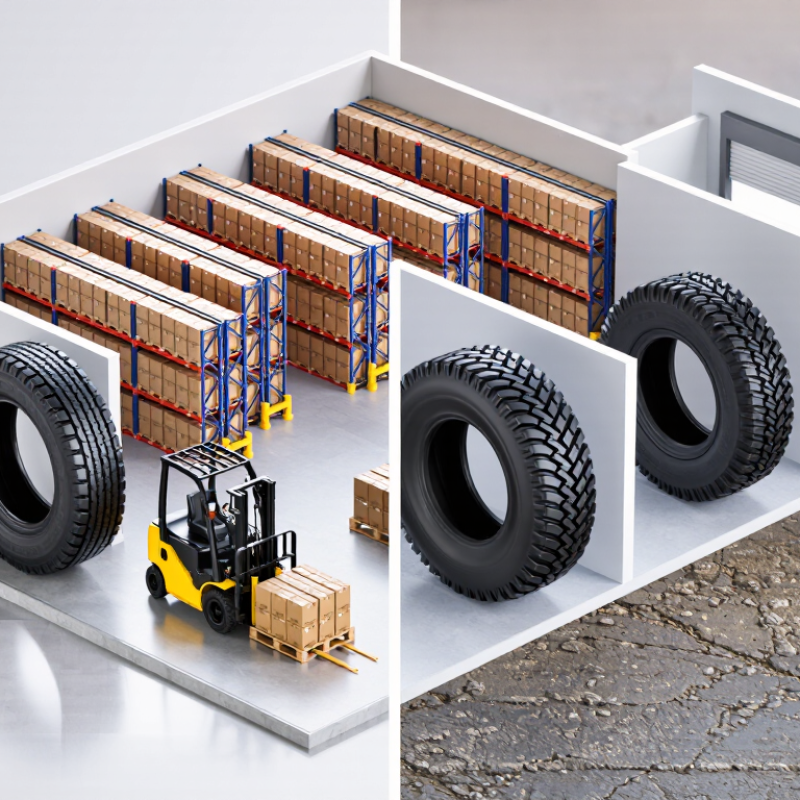
This chart compares common forklift tire types by construction. Cushion and solid pneumatic-shaped tires use solid rubber; pneumatic tires contain compressed air. Cushion tires are commonly used on smooth indoor floors, while pneumatic tires are often chosen for uneven surfaces. Solid pneumatic-shaped tires offer a solid alternative in a pneumatic-style profile.

Comparing Cushion, Pneumatic, and Solid Tire Designs

Cushion, pneumatic, and solid tires behave differently under a loaded forklift. Cushion tires use hard rubber and a compact profile, which suits smooth concrete floors and tight indoor aisles. Their smaller footprint can make turning feel precise. But cracks, dock plates, and loose debris may create a noticeably harsher ride.

Pneumatic tires have deeper tread and more cushioning, especially on uneven yards or rough pavement. Air-filled versions absorb bumps well, though punctures and pressure checks become part of routine maintenance. Solid pneumatic tires keep a similar tread shape without air, reducing flat-related downtime. They can run hotter and feel firmer, so long shifts on rough ground may affect comfort.

Solid cushion tires resist punctures and suit facilities where sharp scraps are a recurring concern. That durability has a trade-off: they transmit more vibration than air-filled tires. Tire choice also depends on load, travel distance, floor condition, and the forklift’s approved specifications. A tire that fits the machine may still be poorly matched to its route. One detail is easy to overlook: a short test on the actual floor can reveal vibration or traction issues that a product sheet cannot. Not perfect, but useful.

Assessing Load Capacity, Tread, and Operating Conditions

Forklift tire selection should begin with the heaviest real load, its load center, and any attachment—not the truck’s headline capacity. OSHA’s powered-industrial-truck standard requires capacity information and other markings to remain legible. Check the data plate, then confirm tire load ratings with the truck or tire documentation. A longer load can shift weight forward, even when its total weight seems acceptable. Small detail. Big consequence.

Tread and tire type must suit the floor and shift pattern. Smooth, clean concrete may suit one setup; wet dock plates, debris, rough thresholds, and frequent tight turns demand different traction and durability. NIOSH’s forklift safety alert reports that overturns account for about 25% of forklift-related deaths. That figure is not a tire-failure rate, but it underscores why stability and operating conditions matter. Inspect for cuts, chunking, uneven wear, and embedded debris; record findings across shifts. A tidy floor plan can still hide a slick patch near a loading bay. I would not choose by tread appearance alone. Check the tire maker’s load and speed limits, and reassess after route or load changes.

Matching Tire Materials to Warehouse Floors and Tasks

Top Warehouse Forklift Tires for Sale

Matching Tire Materials to Warehouse Floors and Tasks

When selecting warehouse forklift tires, start with the floor, not the price. Polyurethane tires suit smooth, sealed concrete and frequent indoor moves; low rolling resistance can help conserve battery energy. Cushion rubber offers more grip and vibration damping on slightly rough floors, though abrasive patches may speed wear. Solid pneumatic tires handle debris and uneven transitions better, but pass more impact through the truck. Match the compound and tread to load weight, turning frequency, and dock crossings.

A glossy aisle and a cracked loading threshold are different jobs. OSHA’s Powered Industrial Trucks eTool cites estimates of roughly 85 forklift-related fatalities and 34,900 serious injuries annually in the United States. These figures are not tire-related, but they underline why predictable steering and braking matter. Inspect for chunking, flat spots, embedded debris, and uneven wear. Replace tires when they reach the manufacturer’s wear limit. A tire can look usable and still perform poorly under a heavy pallet.

Choosing and Buying the Right Forklift Tires for Sale

Top Warehouse Forklift Tires for Sale

Choosing tires starts with the floor, load, and duty cycle—not the sale price. Smooth indoor concrete often suits cushion tires, while rough yards may need pneumatic tires with more compliance. Solid tires resist punctures, but can transmit more vibration across uneven surfaces. Measure the existing tire and check the truck’s data plate before ordering. A wrong size or load rating can affect clearance and rated capacity. Small details matter.

OSHA estimates that forklifts cause about 85 fatal accidents and 34,900 serious injuries each year in the United States. Its powered-industrial-truck safety guidance is not tire-specific, but it underscores why predictable handling matters. Check tread wear, sidewall damage, heat marks, and uneven wear on the tires already fitted. If wear appears on one edge, inspect alignment and operating habits too. A new tire may not fix the cause.

Compare tires by size, construction, load rating, and expected hours per shift. Ask the seller for documented specifications, and confirm compatibility with the forklift manual. For long indoor shifts, heat buildup and vibration deserve attention; for outdoor work, consider debris and surface changes. I would also ask how installation affects warranty coverage. It is easy to focus on purchase cost and overlook downtime. That trade-off deserves a second look.

Top Warehouse Forklift Tires for Sale - Choosing and Buying the Right Forklift Tires for Sale

Tire Type Best-Suited Conditions Key Advantages Points to Consider Buying Checks
Cushion solid Smooth, hard indoor floors and tight warehouse aisles. Compact profile, no air pressure to maintain, and resistant to punctures. Typically intended for smooth indoor surfaces; a firm ride can transmit more vibration. Confirm the forklift is designed for cushion tires. Match the specified tire dimensions and check floor condition and turning clearance.
Pneumatic solid Indoor or outdoor work where puncture resistance is important. Solid construction avoids air-loss downtime and offers a pneumatic-style profile. Generally heavier and less cushioned than air-filled tires; suitability depends on the truck and surface. Verify the tire type, rim compatibility, overall diameter, width, and load rating against the forklift manufacturer’s specifications.
Air-filled pneumatic Outdoor yards, uneven pavement, and some rougher operating surfaces. Air cushioning can improve ride comfort and help absorb surface irregularities. Requires pressure checks and can be punctured. Incorrect pressure affects handling and tire performance. Check the specified size, ply or load rating, inflation pressure, tread pattern, and whether the operating surface is suitable.
Non-marking solid Clean indoor areas where dark tire marks must be reduced, such as food, retail, or finished-goods spaces. Light-colored compounds help reduce visible marks on many floors. “Non-marking” does not guarantee a mark-free floor; dust, debris, and floor coatings can still leave marks. Confirm the compound is suitable for the floor and operating conditions. Ask about wear, heat buildup, and cleaning requirements.
High-traction solid Applications needing additional grip on compatible floors or outdoor surfaces. Tread designs can provide more traction than smooth profiles in suitable conditions. Aggressive tread may increase vibration or wear on smooth floors and may not suit every facility. Compare tread design with the actual surface, debris level, turning demands, and the forklift’s approved tire options.
Polyurethane Selected indoor electric-truck applications, often on smooth floors. Can offer low rolling resistance and good wear characteristics when correctly matched to the truck. Not a universal substitute for rubber tires; floor condition, heat, load, and duty cycle affect suitability. Check the truck maker’s approval, wheel assembly requirements, rated capacity, and the intended duty cycle.

Before ordering: Use the forklift data plate and operator manual to verify tire size, type, load capacity, and approved configuration. Tire specifications and compatibility vary by truck and application; have installation and any required wheel or rim work handled by qualified service personnel.