


What Is a Pull Out Ironing Board Drawer?

What Is a Pull Out Ironing Board Drawer?

A Pull Out Ironing Board Drawer is a compact ironing solution built into a cabinet, wardrobe, or laundry unit. Instead of storing a full-size board against the wall, you slide the drawer forward and unfold its hinged ironing surface. The mechanism keeps pressing equipment close to where clothes are washed, dried, or stored.

In practical use, the drawer may include a heat-resistant cover, folding legs, and space for a spray bottle or iron. Some models rotate or extend, allowing better access in narrow rooms. A well-designed unit should open smoothly, support steady ironing pressure, and close without catching fabric. Installation also matters. The cabinet must provide enough depth, strong mounting points, and safe clearance around heat-producing appliances.

Small details make a difference.

I have found that convenience depends less on appearance than on daily movement. A drawer that sticks after several uses quickly becomes frustrating. The board should also sit at a comfortable working height, because repeated bending can make ordinary ironing tiring. Ventilation and heat protection deserve attention, especially when the iron is stored nearby. Not every cabinet can safely support this design, and product instructions should never be ignored.

This guide explains what a Pull Out Ironing Board Drawer is, how it works, and where it fits best. It also considers sizes, materials, installation concerns, and maintenance. The concept is useful, but not perfect. Limited board width, drawer noise, or reduced weight capacity may affect your choice. Reliable specifications and careful measurements remain more valuable than attractive product photographs.
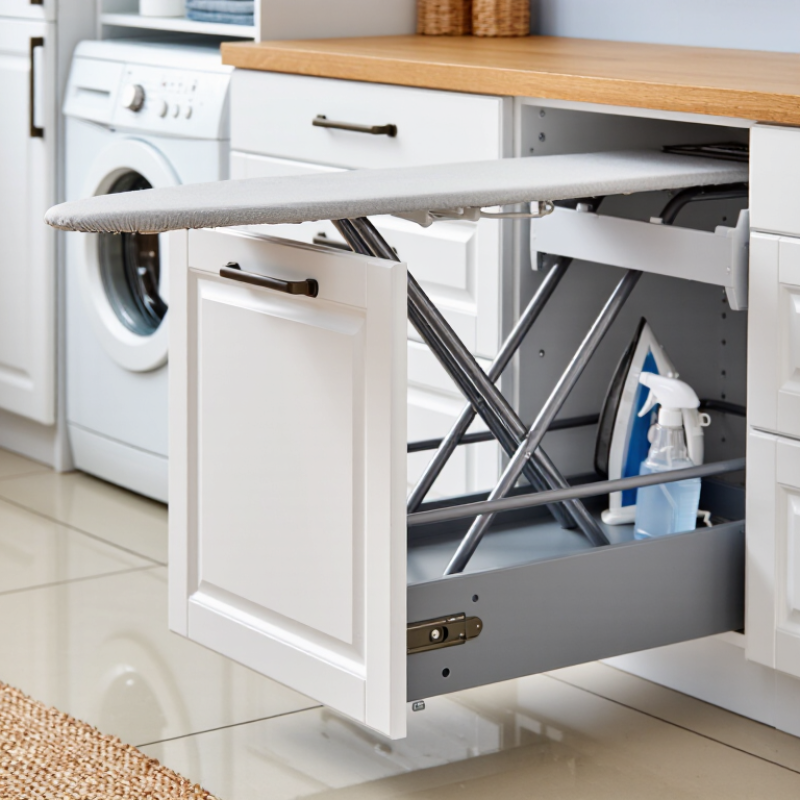
What Is a Pull Out Ironing Board Drawer?

Definition and Core Function of a Pull-Out Ironing Board Drawer

What Is a Pull Out Ironing Board Drawer?

Definition and Core Function of a Pull-Out Ironing Board Drawer

A pull-out ironing board drawer is a built-in storage unit with a compact ironing board inside. It slides from a cabinet, wardrobe, or laundry room fixture. The drawer keeps the board hidden when it is not needed. Its core function is simple: provide a ready-to-use ironing surface without occupying permanent floor space.

Most models use metal runners, a folding board, and a heat-resistant cover. When opened, the board extends forward and locks into a stable working position. Some designs also rotate or fold outward.

The cabinet must have enough depth and strong mounting points. Otherwise, the drawer may wobble during use. That detail is easy to miss.

From practical installation experience, measuring the cabinet opening matters as much as measuring the board. Leave clearance for handles, hinges, and nearby doors. A typical user also needs comfortable elbow space while pressing a shirt or trouser leg. The drawer should move smoothly, without scraping or sudden stops. After ironing, the board must cool before storage. Heat trapped inside a closed cabinet can damage nearby materials.

This solution works especially well in small apartments, bedrooms, and utility areas. It reduces visual clutter and saves setup time.

However, it is not automatically suitable for every cabinet. Poor ventilation, weak hardware, or an undersized compartment can reduce safety and durability. Careful measurement remains essential.

Key Components and Mechanisms Behind Its Operation

What Is a Pull Out Ironing Board Drawer?

Key Components and Mechanisms Behind Its Operation

A pull out ironing board drawer combines compact storage with a folding work surface. The drawer usually moves on metal runners fixed inside a cabinet. These runners guide the board forward and help distribute its weight evenly. Smooth motion depends on accurate installation. Even a small alignment error can cause rubbing, noise, or uneven movement.

Inside the drawer, a hinged ironing board folds into a narrow space. A pivot joint allows the board to open and close. Some designs use a locking support to hold the board flat during use. This support should feel firm, not loose. A heat-resistant cover protects the board and improves fabric movement. Ventilation gaps may also reduce heat buildup beneath the cover. In practice, the latch and runners often receive less attention than the board itself. That is a mistake. A weak latch can let the drawer shift while ironing. The mechanism may work, but not perfectly.

Tips: Check the runner screws regularly. Keep the rails free from lint and dust. Do not exceed the drawer’s stated load capacity. Test the locking support before placing hot clothing on the board. Leave enough clearance around the drawer front. Tight spaces can damage the cabinet or restrict movement. Inspect the hinge after repeated use. It may need adjustment sooner than expected.

Common Designs, Materials, and Installation Configurations

What Is a Pull Out Ironing Board Drawer?

A pull out ironing board drawer hides a compact ironing surface inside a cabinet. It slides forward like a shallow drawer, then folds or swivels into working position. Common designs include single-panel, bi-fold, and rotating boards. Bi-fold models suit narrow utility cabinets, while swivel designs offer better access beside appliances. A single-panel version feels sturdier, but it needs more internal depth.

Manufacturers commonly use powder-coated steel frames, heat-resistant fiberboard, and cotton covers. Steel supports frequent use, while fiberboard reduces weight and noise. Good hardware should include full-extension runners, a locking stop, and smooth hinge movement. The Houzz 2024 U.S. Kitchen Trends Study reported that 94% of renovating homeowners upgraded cabinets. That figure supports the growing demand for specialized storage. Still, a drawer board is not automatically practical. Poor ventilation may trap heat and moisture inside the cabinet.

Installation depends on cabinet width, wall support, and door clearance. Most units fit between 12 and 18 inches of internal space, but measurements vary by design. Secure the runners to solid cabinet sides, not thin decorative panels. Allow space for the board to rotate without striking handles or nearby doors. A professional installer should check screw length and load transfer before final alignment.

Tips: Measure the closed unit first. Test the board fully open. Leave a small heat-safe clearance. Choose washable covers. My own preference is a locking swivel model, although it can feel less rigid during heavy pressing. That trade-off deserves honest consideration.

Benefits and Limitations for Home Storage and Laundry Areas

What Is a Pull Out Ironing Board Drawer?

A pull-out ironing board drawer stores a folding ironing surface inside a cabinet or laundry unit. When needed, the board slides forward and opens at working height. The design keeps fabric tools hidden, while freeing valuable floor space. Space feels calmer. It can also reduce daily bending, especially when the drawer uses full-extension runners and a stable support frame.

The storage benefit is meaningful in compact homes. The National Association of Home Builders’ 2024 What Home Buyers Really Want report identifies a laundry room as a must-have for 86% of buyers. That figure reflects demand for organized laundry areas, not proof that every built-in solution performs well. A drawer may hold the board neatly, but it usually offers limited room for an iron, spray bottle, or pressing cloth. Heat and moisture also create risks. The cabinet should use heat-resistant materials, allow cooling before closure, and keep electrical cords away from hot surfaces. It is not magic.

Installation requires accurate measurements. A narrow cabinet can make the board unstable or difficult to rotate. Heavy runners may need reinforcement, particularly in particleboard units. Users should check the drawer’s weight rating and the board’s locking mechanism before purchase. In practice, the best layout places the drawer near an outlet and clear counter space. My own design preference is cautious: convenient storage matters, but a slightly larger cabinet often works better than a perfectly concealed, cramped drawer.

Maintenance, Safety Practices, and Selection Considerations

What Is a Pull Out Ironing Board Drawer?

Maintenance, Safety Practices, and Selection Considerations

A pull out ironing board drawer is a cabinet-mounted board that slides forward on reinforced runners. It stores flat and saves floor space in laundry rooms, wardrobes, and compact apartments. The drawer usually includes a folding board, heat-resistant cover, locking hardware, and adjustable runners. Its small footprint is useful, but limited clearance can create practical problems.

Maintenance should begin with the runners and fixing screws. Check them monthly for looseness, metal dust, or uneven movement. Wipe the tracks clean and use only the lubricant specified by the manufacturer. Never retract a warm iron beside fabric or wiring. Allow the iron to cool fully. Keep the power cord away from the sliding mechanism. NFPA’s Fire Loss in the United States During 2022 reported 374,300 home structure fires and 11,740 civilian injuries. The report covers all home fires, not ironing equipment specifically, but heat management still deserves attention.

Selection requires more than measuring the cabinet opening. Confirm the board’s extended length, folded depth, weight rating, and ventilation space. Choose a positive locking mechanism, rounded edges, and runners that resist lateral movement. The cabinet material should tolerate occasional steam and moisture. A professional installer should verify wall or carcass reinforcement before fitting the drawer. One detail is easy to miss: the cover may shrink after repeated washing. Replacement covers should match the board’s heat rating and dimensions. My own preference is a slower, smoother runner over a cheaper, faster one; convenience is not safety.

What Is a Pull Out Ironing Board Drawer? - Maintenance, Safety Practices, and Selection Considerations

Data Dimension Typical or Recommended Data Why It Matters Maintenance, Safety, or Selection Action
Definition A compact ironing board stored inside a cabinet drawer or pull-out compartment and extended when needed. It combines ironing functionality with concealed storage and saves floor space. Confirm that the cabinet, drawer, runners, board, and mounting hardware are designed to work as one system.
Common Board Width Approximately 300–450 mm (12–18 in). A wider surface improves garment handling but requires a wider cabinet and stronger hardware. Measure the available internal cabinet width before selecting the board.
Common Board Length Approximately 800–1,200 mm (31–47 in). Longer boards support larger garments but need sufficient drawer depth and clearance. Check the fully extended length, including the front edge and any folding mechanism.
Storage Depth Often about 450–600 mm (18–24 in), depending on the drawer construction. Insufficient depth can prevent the board from closing completely or cause interference with cabinet components. Allow room for runners, brackets, the folded board, and the power cord if an iron storage area is included.
Installed Working Height Generally selected near the user’s elbow height; many installations place the board around 850–1,000 mm (33–39 in) above the floor. A suitable height reduces bending, shoulder strain, and awkward wrist angles. Test the intended height with the user before permanently fixing the cabinet.
Load Capacity Use the manufacturer’s stated rating; compact systems commonly support approximately 10–25 kg (22–55 lb), depending on design. The rating covers the board, iron, and normal downward ironing pressure. Never sit, lean heavily, or place heavy laundry baskets on the extended board.
Drawer Runner Type Full-extension ball-bearing or reinforced roller runners are commonly used. Smooth, supported extension helps prevent binding, uneven loading, and accidental collapse. Inspect for bent rails, loose screws, corrosion, unusual noise, and uneven movement.
Locking or Latching System A positive latch or retention stop should hold the drawer closed and prevent unintended movement when extended. A secure latch reduces pinch, impact, and tip-out hazards. Test the latch regularly and replace it if the drawer opens during transport or closes unexpectedly.
Board Cover Use a heat-resistant, tightly fitted cover with a smooth cotton or heat-rated textile surface. A secure cover improves ironing results and reduces fabric snagging or shifting. Replace covers that are scorched, torn, heavily compressed, or loose around the board.
Heat Protection The board and nearby cabinet surfaces should be protected from direct contact with a hot iron. Heat can discolor, warp, soften, or ignite unsuitable materials. Use a designated heat-resistant iron rest and return the iron only when its soleplate is safely positioned.
Ventilation and Cooling The iron should cool in an open, stable position before being stored in a confined drawer. Trapped heat and moisture may damage the cabinet or create a fire risk. Unplug the iron, empty the water reservoir when appropriate, and allow it to cool fully before closing the drawer.
Electrical Safety The power cord should remain clear of moving runners, sharp edges, hot surfaces, and pinch points. Cord damage can lead to electric shock, short circuits, or fire. Do not operate the iron while the drawer is closed or when the cord is trapped by the drawer front.
Clearance Around Drawer Keep the complete extension path and working area free from doors, handles, walls, and nearby appliances. Obstructions can cause collisions, unstable positioning, or damage to the runners. Open and close the drawer several times after installation to verify unrestricted movement.
Pinch-Point Control Moving gaps may occur at the drawer front, folding hinges, and runner connections. Fingers, clothing, and cables can be caught during operation. Operate the drawer by its handle, keep hands away from joints, and supervise children.
Fasteners and Cabinet Support Mounting screws and cabinet panels must be suitable for the system’s weight and repeated movement. Weak or loose mounting can cause sagging, misalignment, or detachment. Check fasteners every few months and tighten them without overtightening or damaging the cabinet material.
Cleaning Frequency Wipe visible surfaces monthly or whenever starch, dust, or fabric fibers accumulate. Dirt can affect runner performance and transfer onto freshly pressed clothing. Use a slightly damp cloth; avoid flooding the runners or applying unsuitable solvents.
Lubrication Only lubricate runners when the hardware instructions permit it. Incorrect lubricant can attract dust, damage seals, or interfere with the runner mechanism. Follow the hardware instructions and never spray lubricant onto the ironing surface or electrical parts.
Installation Level The cabinet and runners should be installed level and square. Misalignment can cause uneven loading, premature wear, and drawer binding. Use a spirit level during installation and correct cabinet movement before adjusting the runners.
Best Location A dry, accessible area near laundry storage or a suitable power outlet is generally practical. Convenient placement encourages regular use while reducing cable routing and carrying distance. Avoid damp areas, high-traffic routes, unstable flooring, and locations exposed to water splashes.
Selection Priority Prioritize correct dimensions, structural support, safe heat management, smooth operation, and replacement-part availability. A low-cost system may become expensive if it cannot be repaired or does not fit the cabinet correctly. Compare measured space and safety requirements before considering appearance or price alone.