


How to Choose the Right Cable Assembly Manufacturer?
A cable assembly can look simple on a drawing and still fail under real operating conditions. A loose crimp, incorrect wire gauge, or poorly sealed connector may cause costly downtime. Choosing a manufacturer, therefore, means looking beyond a low quotation or polished website. Ask how the supplier handles design reviews, material changes, process control, and testing. Then check whether its answers are specific and supported by records.
Taiichi Ohno, a manufacturing pioneer, offered a useful warning: “Having no problems is the biggest problem of all.” For cable assembly buyers, that idea matters. A manufacturer that reports defects, explains root causes, and documents corrective actions may be more trustworthy than one claiming a flawless record. Evidence counts. Request sample inspection reports, traceability details, and relevant test results. If possible, review a representative assembly and inspect its labels, conductor placement, crimps, and strain relief.
The right partner should also ask questions about the application: vibration, temperature, bend radius, and installation space. Those details can change material and connector choices. A capable team will flag uncertainties before production, not hide them inside a finished batch. Still, no checklist removes every risk. I would treat vague assurances as a reason to investigate further, not as proof of poor quality. The sections ahead explain how to assess technical capability, quality systems, communication, and total cost before making a decision.
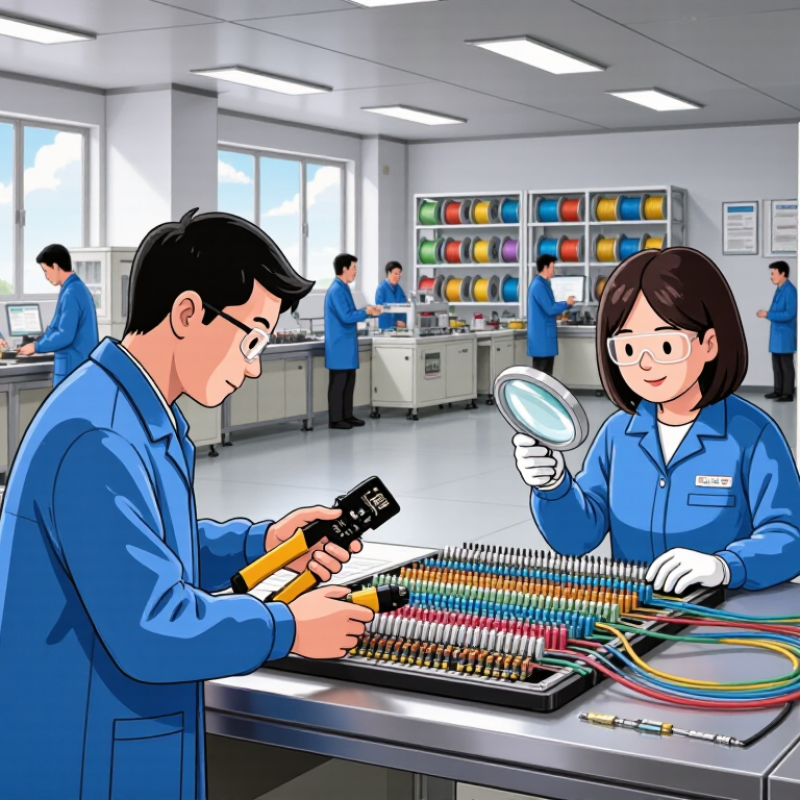
Define Your Cable Assembly Requirements and Application
Before comparing manufacturers, define where the cable will work and what it must carry. Record operating voltage, peak current, signal type, ambient temperature, and expected service life. IEA’s Electricity 2024 report recorded 2.2% global electricity-demand growth in 2023 and forecast 3.4% annual growth for 2024–2026. That wider demand is not a cable specification. It does make load assumptions worth documenting. A cable inside a warm cabinet needs different insulation from one exposed to sunlight, oil, or repeated movement.
Describe the physical details too: cable length, connector orientation, minimum bend radius, shielding, and abrasion exposure. How often will it flex? A robotic arm moving thousands of times daily needs a different construction from a fixed control panel. Include drawings, photos, and a sample operating cycle when requesting quotes. Small details matter. Also define acceptance checks, such as continuity, pull force, and fit in the finished enclosure. A spreadsheet may look complete while missing one awkward condition: cleaning chemicals, vibration, or a tight routing path. Revisit those assumptions with engineering and production teams before asking a manufacturer to recommend materials or tooling.
How to Choose the Right Cable Assembly Manufacturer? - Define Your Cable Assembly Requirements and Application
Use this checklist to define the assembly before requesting quotations. Example specifications are illustrative; confirm final requirements against the product design, applicable standards, and operating conditions.
| Requirement Area | Information to Define | Illustrative Example | What to Verify with the Manufacturer |
|---|---|---|---|
| Application and operating environment | Where the cable will be used, expected operating conditions, exposure to moisture, dust, chemicals, vibration, or outdoor weather. | Indoor industrial equipment with regular vibration and occasional exposure to cleaning fluids. | Experience producing assemblies for similar conditions; ability to recommend suitable materials, sealing methods, and strain relief. |
| Electrical requirements | Operating voltage, current, signal type, number of circuits, shielding needs, and any relevant electrical safety requirements. | Low-voltage power and control signals in separate conductors, with shielding specified for the signal pair. | Whether the proposed wire, insulation, connectors, and shielding meet the stated electrical and application requirements. |
| Cable construction and materials | Conductor material and size, insulation and jacket material, conductor count, shielding, and flexibility needs. | Flexible stranded copper conductors with a jacket selected for the installation environment. | Material availability, construction options, traceability, and documentation for specified materials. |
| Mechanical design and dimensions | Overall length, branch lengths, connector orientation, bend requirements, mounting features, and allowable dimensional tolerances. | A two-branch harness with defined connector positions and drawing-controlled overall dimensions. | Ability to build from controlled drawings or samples, manage tolerances, and inspect critical dimensions. |
| Connectors and interface | Connector type, pinout, keying, contact configuration, mating interface, and any required backshells or accessories. | Keyed connectors with a documented pin-to-pin wiring schedule. | Connector sourcing and compatibility checks; controls for pinout, crimping, and connector assembly. |
| Standards and compliance | Applicable industry, customer, or regulatory requirements, including any requirements for materials, testing, or records. | Customer-defined workmanship criteria and specified component compliance documentation. | Which requirements the manufacturer can support, what evidence is available, and whether any requirements need independent validation. |
| Testing and inspection | Required checks, acceptance criteria, sampling level, test records, and identification or labeling requirements. | Continuity and short-circuit checks for each assembly, with results retained by lot. | Test equipment and procedures, calibration controls, inspection records, and the process for handling failed units. |
| Volume, schedule, and change control | Prototype quantity, expected production demand, delivery schedule, packaging needs, and process for approving design changes. | Initial prototype build followed by recurring production orders, with revisions controlled by drawing level. | Capacity planning, lead-time assumptions, revision control, production consistency, and communication of material or process changes. |
Related Posts
-
2026 Best Control Cable Options for Global Buyers
-
Top 10 Control Cable Types for Optimal Performance in Industrial Applications
-
Why Choose a 4 Wire Cable for Your Electrical Projects?
-

What is Wire and Cable and How Are They Used in Everyday Applications?
-

Top Cable Assembly Trends for Global Buyers in 2026?
-
How to Choose the Right Wire and Cable for Your Needs?